Floor Register Sizes: Standard Sizes, How to Measure & Selection Guide (2026)
Choosing the right floor register size sounds simple — measure the hole, buy the register. But homeowners and contractors regularly order the wrong size because of a common confusion: the size on the box refers to the duct opening, not the overall register face. A "4×10" register doesn't have a 4×10 inch face; it has a face that's approximately 5.5×11.5 inches, designed to cover a 4×10 inch duct opening.
This guide clears up the sizing confusion, lists every standard floor register size, explains how to measure correctly, and helps you pick the right type for each room.

Standard Floor Register Sizes (US Residential)
Floor register sizes in the US are specified by the duct opening dimensions (width × length), measured in inches. Here are all standard sizes:
| Duct Opening | Face Size (approx.) | CFM Range | Typical Room |
|---|---|---|---|
| 2 × 10 | 3.5 × 11.5 in. | 20-40 | Small closets, toe-kick |
| 2 × 12 | 3.5 × 13.5 in. | 25-50 | Toe-kick, under-cabinet |
| 2 × 14 | 3.5 × 15.5 in. | 30-55 | Baseboard, narrow spaces |
| 4 × 8 | 5.5 × 9.5 in. | 40-75 | Small bedrooms, bathrooms |
| 4 × 10 | 5.5 × 11.5 in. | 50-100 | Bedrooms, hallways (most common) |
| 4 × 12 | 5.5 × 13.5 in. | 60-120 | Bedrooms, dining rooms |
| 4 × 14 | 5.5 × 15.5 in. | 70-140 | Living rooms, larger bedrooms |
| 6 × 10 | 7.5 × 11.5 in. | 80-150 | Living rooms, family rooms |
| 6 × 12 | 7.5 × 13.5 in. | 100-180 | Master bedrooms, great rooms |
| 6 × 14 | 7.5 × 15.5 in. | 120-200 | Large living areas, basements |
| 8 × 14 | 9.5 × 15.5 in. | 150-250 | Large rooms, commercial |
| 10 × 10 | 11.5 × 11.5 in. | 130-220 | Square openings, returns |
How to Measure for a Floor Register
Getting the measurement right is the single most important step. Here's how:
Step 1: Remove the old register (if replacing). Lift it straight up out of the opening — most floor registers just drop in without screws.
Step 2: Measure the duct opening — the rectangular hole in your floor. Measure the inside dimensions: width (shorter side) × length (longer side). Measure in inches.
Step 3: Round to the nearest standard size. If you measure 3.75 × 9.75 inches, that's a 4×10 duct opening. The opening is usually cut slightly smaller than the nominal size.
Common mistake: Do NOT measure the old register's face. The face is always 1.5-2 inches larger than the duct opening. If you order a register matching the face size, you'll get one that's too big for the hole.
Floor Register Types by Function
Supply Registers (with Damper)
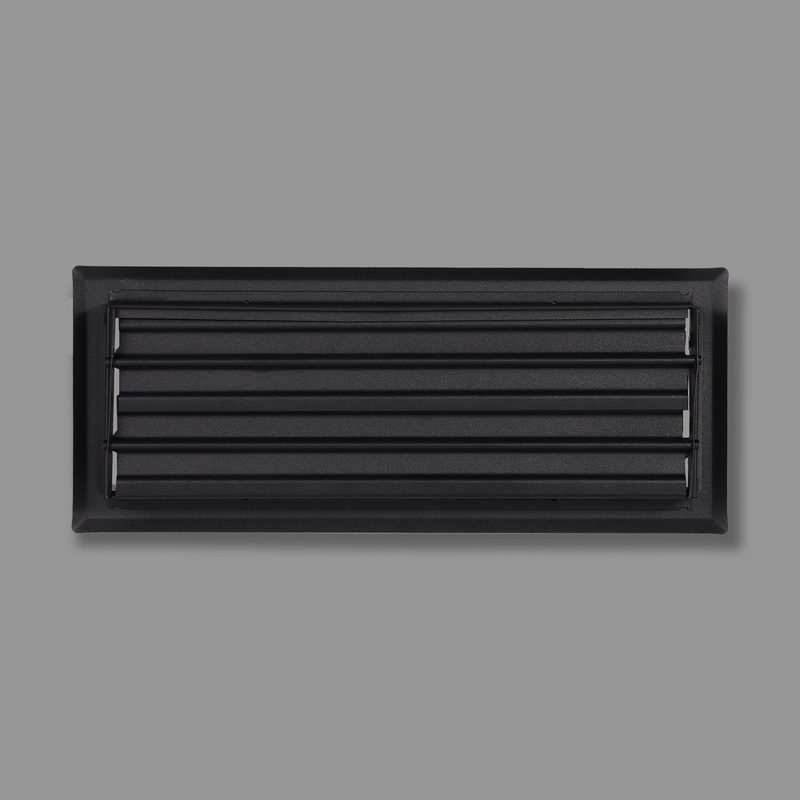
For supply air — the vents that blow heated or cooled air into the room. These have adjustable louver blades controlled by a lever or knob. You can open, close, or partially restrict airflow to balance room temperatures.
Return Air Grilles (No Damper)
For return air — the vents that pull room air back to the HVAC system. These are fixed grilles without adjustable blades. They typically have larger openings and less restriction to allow maximum airflow back to the unit.
Floor Diffusers
A subtype of supply register designed to spread air in multiple directions rather than blowing straight up. The blade angles are preset to diffuse air outward in 1-way, 2-way, or 4-way patterns. Common in commercial applications and under windows.
Floor Register Styles: Standard vs Decorative
Standard stamped-steel registers are the default — plain white, brown, or unpainted steel. They're functional and cheap ($3-8 each), but they look like what they are: generic HVAC hardware.
Decorative floor registers are the upgrade: laser-cut patterns (Victorian scroll, basket weave, Art Deco geometric), premium finishes (matte black, antique brass, satin nickel, rose gold), and heavier-gauge steel construction. They cost more ($15-40 each) but transform an eyesore into a design element.

For a complete guide to decorative options, patterns, and finishes, see our Decorative Floor Register Guide.
How Many Floor Registers Per Room?
The number of registers per room depends on the room's heating/cooling load (BTU requirement), which is determined by room size, insulation, window area, and climate zone. As a rough rule of thumb:
| Room Size | Typical Registers | Common Sizes Used |
|---|---|---|
| Small (under 150 sq ft) | 1 register | 4×10 or 4×12 |
| Medium (150-300 sq ft) | 1-2 registers | 4×12, 4×14, or 6×10 |
| Large (300-500 sq ft) | 2-3 registers | 6×12 or 6×14 |
| Great room (500+ sq ft) | 3-4 registers | 6×14 or multiple 4×12 |
A typical 3-bedroom home has 8-12 floor registers total. This is useful context for contractors and distributors estimating quantities.
Floor Register Materials
Steel — The most common material. Strong, supports foot traffic, available in standard and decorative styles. Powder-coated for color. Our laser-cut decorative registers use 20-22 gauge steel.
Aluminum — Lighter than steel, won't rust. Good for humid environments (basements, bathrooms). Less rigid — can flex under heavy loads.
Cast Iron — The premium option. Extremely heavy and durable. Classic look for Victorian-era and historic homes. Significantly more expensive and harder to ship.
Wood — Specialty registers made from oak, maple, or walnut to match hardwood flooring. High-end but limited airflow due to thicker construction.
Where to Source Floor Registers in Bulk
Airwise manufactures standard and decorative floor registers at our Dongyang, China facility with factory-direct pricing. Our product range includes standard steel floor registers, heavy-duty models, and our new laser-cut decorative register line in matte black, antique brass, satin nickel, and rose gold finishes.
MOQ starts at 100 pieces for standard items and 500 pieces for custom patterns or finishes. Lead time is 15-25 days for standard, 30-45 days for custom.
Floor Register Sizes — FAQ
What is the most common floor register size?▾
The 4×10 inch floor register is the most common size in US residential construction. It fits a 4×10 inch duct opening (the opening in the subfloor). The overall face size is approximately 5.5×11.5 inches. This size is standard for bedrooms, hallways, and small to medium rooms.
How do I measure for a replacement floor register?▾
Measure the duct opening in the floor — the hole itself, not the old register face. Measure width × length in inches. Common openings: 4×10, 4×12, 4×14, 6×10, 6×12, 6×14. The register you buy should match the duct opening size; the face will be about 1.5-2 inches larger in each dimension to overlap the opening.
What is the difference between a register and a grille?▾
A register has adjustable damper blades (louvers) that let you control airflow — open, close, or partially restrict. A grille has no damper and is fixed/non-adjustable. Registers are used for supply air (heated or cooled air blowing into the room). Grilles are typically used for return air (air being pulled back to the HVAC system). Read our full comparison guide.
Can I use a larger floor register than my duct opening?▾
No. The register must match the duct opening. A larger register will not sit flat — it needs the duct rim to rest on. If you want more airflow to a room, the duct size needs to be changed by an HVAC contractor, not just the register.
What floor register material is best for high-traffic areas?▾
Steel or cast iron registers are strongest for high-traffic areas — they support foot traffic and furniture without bending. Aluminum registers are lighter but can dent under heavy loads. For the most durable option in decorative styles, choose laser-cut steel registers. View our decorative registers.
Standard and decorative, any quantity
Steel, aluminum, laser-cut decorative. MOQ 100 pcs. Quote within 12 hours.