Insulated vs Non-Insulated Flex Duct: R-Value, Cost & When to Use Each
We manufacture both insulated and non-insulated flexible duct — and the question we get most from HVAC contractors is not "which one is better?" but "where does each one actually belong?" The answer depends on where the duct runs, what climate zone the job is in, and whether condensation or energy loss is the bigger risk. This guide gives you the data to make that call.
Quick Answer
Use insulated flex duct (R-6 or R-8) for any run through unconditioned space — attics, crawl spaces, garages, and unheated basements. Use non-insulated flex duct only inside conditioned spaces — interior wall cavities, between conditioned floors, or as short connector runs from a branch takeoff to a ceiling diffuser within a heated/cooled plenum. When in doubt, insulate: the material cost difference is $1.50-$4.00 per foot, but the energy penalty for skipping insulation in an unconditioned attic is 25-40% of your delivered heating or cooling capacity.
In This Guide
- 1. What Makes Flex Duct "Insulated"
- 2. Head-to-Head Comparison Table
- 3. R-Value Explained: R-4.2, R-6 and R-8
- 4. When to Use Insulated Flex Duct
- 5. When Non-Insulated Flex Duct Is the Right Call
- 6. Energy Savings and Payback Data
- 7. Building Code Requirements by Climate Zone
- 8. Installation Tips from the Factory Floor
- 9. Cost Breakdown and ROI
- 10. FAQ
1. What Makes Flex Duct "Insulated"
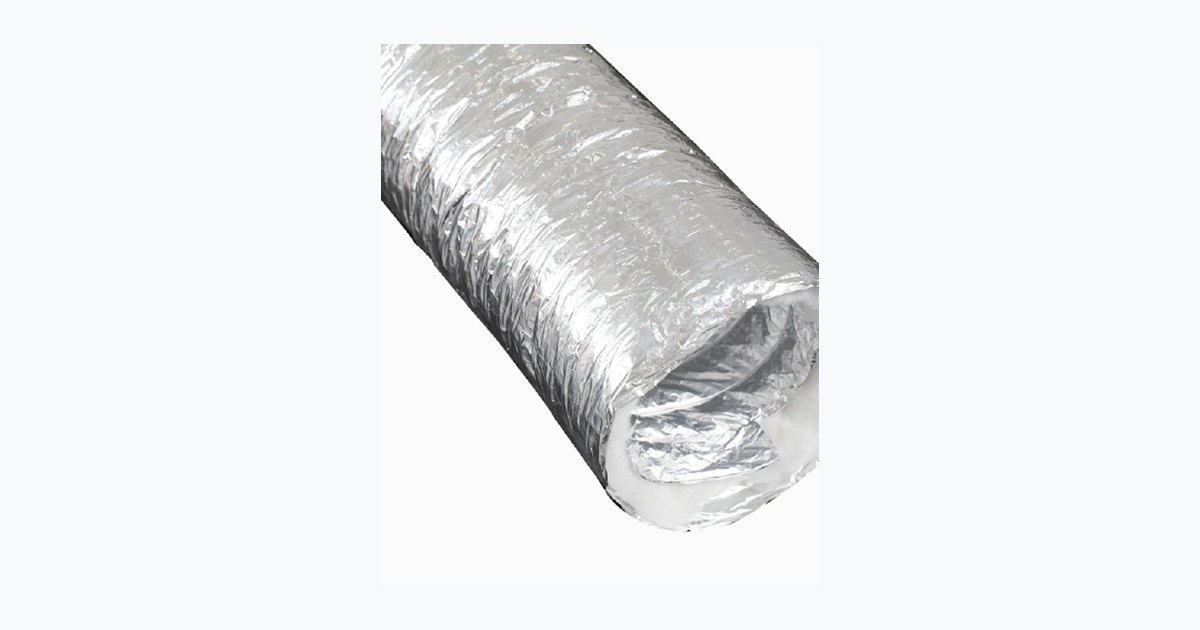
All flexible duct starts with the same inner core — a helical wire spring wrapped in a polyester or metalized polyester film that forms the air channel. Non-insulated flex duct stops there: core plus outer jacket for handling durability.
Insulated flexible duct adds two layers around that core:
- Thermal blanket. Fiberglass (most common, available from R-4.2 to R-8) or polyester fiber (for fiberglass-free specs). The blanket thickness determines the R-value — typically 1 inch for R-4.2, 1.5 inches for R-6, and 2 inches for R-8.
- Vapor barrier jacket. A reinforced metalized polyester or polyethylene outer skin that blocks moisture migration into the insulation. This jacket is the critical condensation barrier and must remain continuous and sealed at every joint.
The manufacturing distinction matters for one reason: R-value is a function of blanket thickness and density, not of the core construction. A higher R-value means a physically larger outside diameter — an 8-inch R-8 flex duct has an OD of roughly 12 inches versus 8.5 inches for the non-insulated version. That size difference drives real framing and clearance constraints, which we cover in the installation section below.
2. Head-to-Head Comparison Table
This table compares insulated and non-insulated flex duct across the dimensions that matter for specification and installation. All data is based on 8-inch diameter duct at standard conditions.
| Dimension | Non-Insulated Flex Duct | Insulated Flex Duct (R-8) |
|---|---|---|
| R-Value | R-0 (core film only) | R-4.2 / R-6 / R-8 |
| Outer diameter (8" duct) | ~8.5" | ~12" (R-8) |
| Weight per foot | 0.15-0.25 lb/ft | 0.45-0.70 lb/ft (R-8) |
| Material cost per foot | $0.75-$1.25 | $2.50-$5.50 (R-8) |
| Temperature loss per 10 ft (90 degF attic) | 8-12 degF | 1-2 degF (R-8) |
| Condensation risk | High in cooling mode | Low (sealed vapor barrier) |
| Max operating temperature | 250 degF (typical) | 250 degF (glass fiber blanket) |
| Bend radius (min) | 1x diameter | 1x diameter (but larger OD) |
| Code-compliant in unconditioned attic | No | Yes (R-6 or R-8 per IECC zone) |
| Typical application | Interior conditioned space, exhaust | Attics, crawl spaces, garages |
Data based on 8-inch diameter flex duct. Costs are 2026 wholesale USD; retail pricing is typically 40-60% higher. Temperature loss assumes 400 CFM airflow, 55 degF supply air, 140 degF attic ambient.
3. R-Value Explained: R-4.2, R-6 and R-8
R-value measures thermal resistance — the higher the number, the slower heat moves through the insulation. For flexible duct, three R-values cover virtually all residential and light commercial applications:
| R-Value | Blanket Thickness | OD Increase (8" core) | Primary Use |
|---|---|---|---|
| R-4.2 | ~1.0" | +2.0" (10" OD) | Conditioned crawl spaces, between-floor runs, condensation prevention on interior cooling lines |
| R-6 | ~1.5" | +3.0" (11" OD) | IECC Climate Zones 1-4 attics, heated garages, mild-climate crawl spaces |
| R-8 | ~2.0" | +4.0" (12" OD) | IECC Climate Zones 5-8 attics, extreme-temperature crawl spaces, high-humidity regions |
A practical note from our production line: R-6 and R-8 flex duct use the same fiberglass blanket material at the same density — the only difference is thickness. That means R-8 has the same flexibility and handling characteristics as R-6; it is just 1 inch larger in radius. If your framing and clearances can accommodate R-8, there is no installation penalty for choosing the higher value. The material cost premium from R-6 to R-8 is typically only $0.50-$1.00 per foot.
4. When to Use Insulated Flex Duct
The rule is simple: insulate any duct run that passes through unconditioned space. In practice, these are the five situations where insulated ducting is required or strongly recommended:
- Unconditioned attics. This is the highest-impact application. A vented attic in Climate Zone 2 (Houston, Phoenix) regularly reaches 140-160 degF in summer. Supply air at 55 degF passing through non-insulated flex duct in that attic loses 8-12 degF per 10 feet of run — by the time it reaches a register 30 feet from the air handler, you are delivering 80 degF air instead of 55 degF. R-8 cuts that loss to 1-2 degF per 10 feet.
- Vented crawl spaces. Winter temperatures in the crawl space can drop to 30-40 degF in northern climates, making the heating supply duct a major loss path. R-6 minimum; R-8 in Zones 5-8.
- Unheated garages. The garage-to-house duct penetration is often overlooked. Any flex duct running through an unconditioned garage needs insulation — and fire-rated insulation if code requires a fire separation.
- Exterior chases and soffits. These are technically "inside the wall" but are often outside the thermal envelope. If the chase is not insulated and air-sealed, the duct inside it needs its own insulation.
- Long horizontal runs inside conditioned space (cooling only). Even inside conditioned space, a 55 degF supply duct running through 75 degF room air will sweat if the humidity is above 60% RH. R-4.2 is sufficient to prevent condensation in most interior applications.
Need insulated flex duct quoted by diameter and R-value? We manufacture R-4.2, R-6, and R-8 insulated flex duct in 4" through 20" diameters. Send us your takeoff and we will return pricing within 24 hours.
Request flex duct pricing →5. When Non-Insulated Flex Duct Is the Right Call
Non-insulated flexible duct is not an inferior product — it is the correct product for runs that stay inside conditioned space where thermal loss and condensation are not concerns:
- Return air connections. Short connector runs from a return grille to a return air plenum inside conditioned space. Temperature differential is near zero, so insulation adds cost without benefit.
- Interior supply takeoffs. The last 3-6 feet from a rigid branch to a ceiling diffuser inside a conditioned plenum space above a dropped ceiling. Our plenum box sizing guide covers this connection in detail.
- Exhaust and ventilation runs inside conditioned space. Bathroom and kitchen exhaust ducts that run entirely within conditioned walls or ceilings before exiting through a wall or roof vent.
- Temporary and construction uses. Temporary heating/ventilation during construction, where the duct is discarded after the project.
- Heating-only systems in mild climates. In dry climates where heating supply temperatures are only slightly above room temperature (e.g., radiant-assisted systems), interior non-insulated flex is sometimes acceptable — but check your local code.
The key principle: if both the air inside the duct and the air outside the duct are within 15 degF of each other, and the exterior humidity is below 55% RH, non-insulated flex duct is functionally equivalent to insulated. Outside those bounds, insulate.
6. Energy Savings and Payback Data
The U.S. Department of Energy estimates that duct losses in unconditioned spaces account for 25-40% of total HVAC energy consumption in homes with poorly insulated or uninsulated ductwork. The math on insulated ducting is straightforward:
| Scenario | Non-Insulated | R-6 Insulated | R-8 Insulated |
|---|---|---|---|
| Heat gain per 10 ft (140 degF attic, 55 degF supply) | 8-12 degF | 2-3 degF | 1-2 degF |
| Delivered air temp at 30 ft register | ~79-91 degF | ~61-64 degF | ~58-61 degF |
| Cooling capacity delivered | ~60-70% | ~90-93% | ~94-97% |
| Annual energy waste (2,500 sq ft home, Zone 2) | $400-$650/yr | $80-$130/yr | $40-$80/yr |
| Insulation material cost (100 ft, 8" duct) | $75-$125 | $200-$400 | $250-$550 |
| Payback period | n/a | 6-18 months | 8-24 months |
Based on 100 linear feet of 8-inch duct in an unconditioned attic, 400 CFM airflow, Climate Zone 2 (Houston/Phoenix). Energy costs at $0.13/kWh. Actual savings vary by system efficiency, duct layout, and local rates.
The payback is even faster in retrofit scenarios where existing non-insulated or deteriorated ductwork is being replaced. In those cases, the incremental cost of choosing R-8 over non-insulated is often less than one cooling season of energy savings.
7. Building Code Requirements by Climate Zone
The International Energy Conservation Code (IECC 2021) sets minimum insulation requirements for ductwork based on where the duct runs relative to the building envelope. Most state and local codes adopt IECC with amendments, so always verify with the Authority Having Jurisdiction (AHJ) — but these are the baseline requirements:
| IECC Climate Zone | Duct in Unconditioned Attic | Duct in Other Unconditioned Space | Duct in Conditioned Space |
|---|---|---|---|
| Zones 1-2 (Miami, Houston, Phoenix) | R-8 | R-6 | No requirement |
| Zones 3-4 (Atlanta, Dallas, Nashville) | R-8 | R-6 | No requirement |
| Zones 5-6 (Chicago, Denver, Boston) | R-8 | R-8 | No requirement |
| Zones 7-8 (Minneapolis, Fairbanks) | R-8 | R-8 | No requirement |
Per IECC 2021 Table R403.3.1. Some jurisdictions (California Title 24, Florida, Texas) have stricter requirements. Always verify with the local AHJ before specifying.
A common misunderstanding: these code minimums are for new construction and major renovations. Existing homes with non-insulated ductwork are typically grandfathered — but if you are replacing ductwork, most jurisdictions require the new installation to meet current code. For contractors, that means stocking R-8 covers almost every scenario across all eight climate zones.
8. Installation Tips from the Factory Floor
We see flex duct come back as warranty claims when installation shortcuts undo the thermal and structural performance the product was designed to deliver. These are the five installation practices that make the difference between a 20-year duct system and a callback in year two.
Tip 1: Fully extend the duct before cutting
Flex duct ships compressed — a 25-foot piece may be packed into a 5-foot box. If you cut and install it partially compressed, the inner core bunches up and creates turbulence that increases static pressure by 0.05-0.15 in. w.g. per 10 feet. That is the equivalent of adding an extra fitting to every run. Stretch the duct to its full extended length, then cut to the measurement plus 2-3% for slack at connections. Our CFM and duct sizing guide includes the pressure drop tables that show why this matters.
Tip 2: Support every 4-5 feet, maximum 0.5-inch sag
Flex duct has no structural rigidity — if it sags between supports, the bottom of the duct compresses and the effective cross-section shrinks. ACCA Manual D and SMACNA allow a maximum sag of 0.5 inches per foot of support span. For insulated flex duct, use 1.5-inch-wide nylon or polypropylene straps (not wire or zip ties, which crush the insulation and break the vapor barrier). Space supports at 4-5 foot intervals and at every change of direction.
Tip 3: Seal every connection with mastic, not just tape
UL 181B-FX listed tape is code-compliant for flex duct connections, but our recommendation — and ACCA's recommendation — is mastic plus mechanical fastener plus tape. A draw band or clamp secures the inner core to the collar, mastic seals the gap, and tape over the insulation jacket seals the vapor barrier. This triple-seal approach addresses duct leakage — which the U.S. DOE estimates wastes another 10-20% of system capacity on top of thermal losses through the insulation. See our duct sealing methods guide for the full procedure.
Tip 4: Maintain minimum bend radius
The minimum bend radius for flex duct is 1x the duct diameter — an 8-inch duct should turn no tighter than an 8-inch centerline radius. Sharper bends kink the inner core, reduce airflow by 15-40% at the bend, and in insulated duct, compress the blanket at the inner radius, creating a thermal weak spot. If the routing requires a tighter turn, use a sheet metal elbow and transition back to flex after the turn.
Tip 5: Do not allow insulated duct to contact hot surfaces
Flex duct insulation is rated for up to 250 degF ambient, but prolonged contact with a hot flue pipe, recessed light housing, or exhaust duct can melt the vapor barrier and degrade the fiberglass. Maintain a minimum 3-inch clearance from heat sources, and use a fire-rated wrap or metal sleeve where code requires fire separation at penetrations.
9. Cost Breakdown and ROI
Contractors evaluating insulated vs non-insulated flex duct often compare per-foot material costs in isolation. Here is what the full installed cost looks like for a typical 100-foot, 8-inch duct run in an unconditioned attic:
| Cost Component | Non-Insulated | R-6 Insulated | R-8 Insulated |
|---|---|---|---|
| Flex duct (100 ft) | $75-$125 | $200-$400 | $250-$550 |
| Connectors, clamps, mastic | $40-$60 | $40-$60 | $40-$60 |
| Hangers and supports | $25-$40 | $30-$50 | $30-$50 |
| Labor (2-person crew, 3-4 hrs) | $300-$500 | $350-$550 | $350-$550 |
| Total installed cost | $440-$725 | $620-$1,060 | $670-$1,210 |
| Incremental cost vs non-insulated | — | $180-$335 | $230-$485 |
| Annual energy savings (Zone 2 attic) | — | $280-$500 | $320-$570 |
The takeaway: insulation is only 25-40% of the installed cost difference. Labor, connectors, and hangers are essentially the same for both products. The incremental cost of upgrading from non-insulated to R-8 is $230-$485 on a 100-foot run — and the energy savings in an unconditioned attic pay that back in the first year.
For contractors buying in volume, our factory-direct pricing on insulated flex duct is 30-50% below typical U.S. distribution. We ship R-4.2, R-6, and R-8 in 4" through 20" diameters, with MOQ starting at 100 pieces per size. Browse the product catalog or request a quote for project pricing.
Related Guides
- Insulated vs Non-Insulated Rigid Duct: R-Value Comparison — the same decision for rigid sheet metal ductwork
- HVAC Ducting Materials Comparison — flex vs rigid vs spiral across all performance metrics
- HVAC CFM and Duct Sizing Calculator — getting the diameter right before choosing insulation
- Duct Sealing Methods Guide — mastic, tape, and aerosol sealing for flex and rigid duct
- Duct Fittings Types: Contractor Guide — connectors, collars, and transitions for flex duct terminations
- HVAC Noise Control and Duct Silencer Guide — when flex duct is the noise source, not the solution
- Spiral vs Rectangular Duct Comparison — rigid alternatives when flex duct is not the right fit