Return Air Grille Types Compared: Why Fin Angle Costs More Than Free Area
We build 30 return and filter grille models: stamped fin, fixed bar, egg crate and perforated, in steel and aluminum. Buyers almost always choose between them on free area. The catalogue data says that is the wrong number to compare. The core's geometry, especially how hard it makes the air turn, decides pressure loss and noise far more than the size of the holes.
Quick Answer
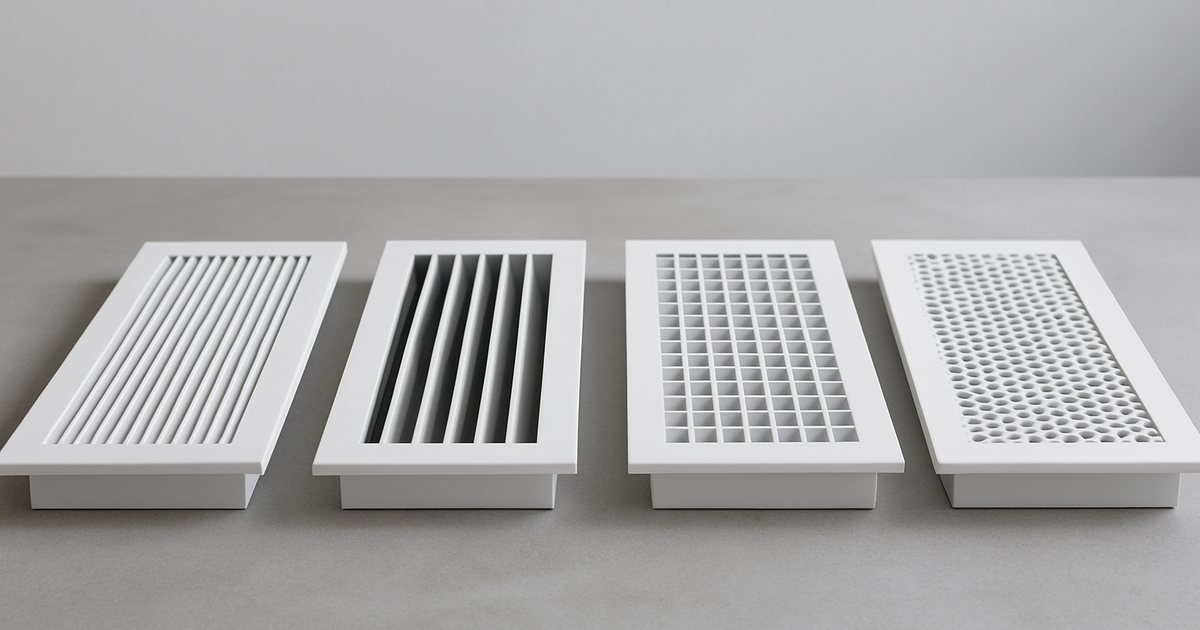
There are five return air grille types: stamped fin (inclined fins lanced from the face), fixed bar (separate deep blades at 0°, 35° or 45°), egg crate (open cube core), perforated face (punched sheet) and filter grilles (any face on a hinged filter door). Choose by what the grille must hide and how quiet it must be, not by free area alone. In Hart & Cooley's published data, two stamped returns with almost the same effective area (Ak 66–69% of nominal) differ by up to 86% in pressure loss at 500 FPM. The cause is fin angle (20° vs 40°), not open area. Egg crate is the quietest and least concealing. Perforated is the cleanest-looking and least open (about 51% for 3/16 in holes on 1/4 in centres). Filter grilles should run at 2 CFM per in² of filter, which is 288 FPM.
Key Takeaways
- A 1/2 in fin at 40° loses 0.054 in. w.g. at 500 FPM. A 1/3 in fin at 20° loses 0.029. Their Ak values are within 7%.
- To match the 20° grille's pressure, the 40° grille must run at about 366 FPM. At 800 CFM that means a 20x24 instead of a 24x14, 43% more wall.
- Perforated open area = 90.69 × (d/c)². A 3/16 in hole on 1/4 in centres is 51.0% open, against 74.3% for a 1/2 in egg crate core, so it needs about 46% more core area at the same through-hole velocity.
- A blade hides the duct straight-on only if blade depth × sin(angle) ≥ spacing. A 45° blade at 1/2 in spacing needs at least 0.71 in of depth.
- "45°" and "90°" grilles can describe the same blade. Some catalogues measure the angle from the face, others from the face normal. Write the reference into the spec.
In This Guide
- 1. The Five Return Grille Types at a Glance
- 2. Stamped Fin Grilles: The 86% Pressure Penalty of a Steeper Fin
- 3. Fixed Bar Grilles: When Angle Actually Hides the Duct
- 4. Egg Crate Grilles: Most Open, Least Hidden
- 5. Perforated Face Grilles: Calculate the Open Area Yourself
- 6. Filter Grilles: Two Rules That Disagree
- 7. Options: Dampers, Insulated Backs and Door Transfer Grilles
- 8. Worked Example: One 800 CFM Return, Four Answers
- 9. How to Specify a Return Grille So You Get What You Sized
- 10. FAQ
1. The Five Return Grille Types at a Glance
A return grille is just a hole with a face on it. The face has three jobs: hide the duct, survive cleaning and knocks, and get out of the air's way. The five core types trade those jobs against each other differently. Start with the summary, then read the sections for the numbers behind each row.
| Type | Core geometry | Open / effective area | Hides duct? | Noise at a given CFM | Best for |
|---|---|---|---|---|---|
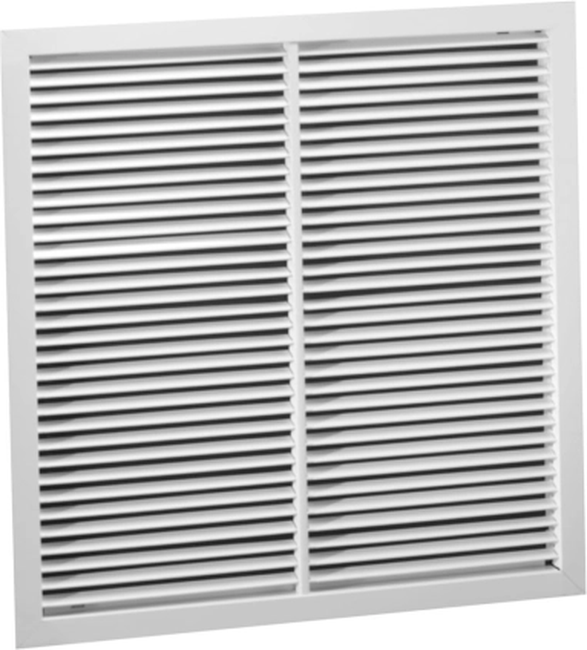
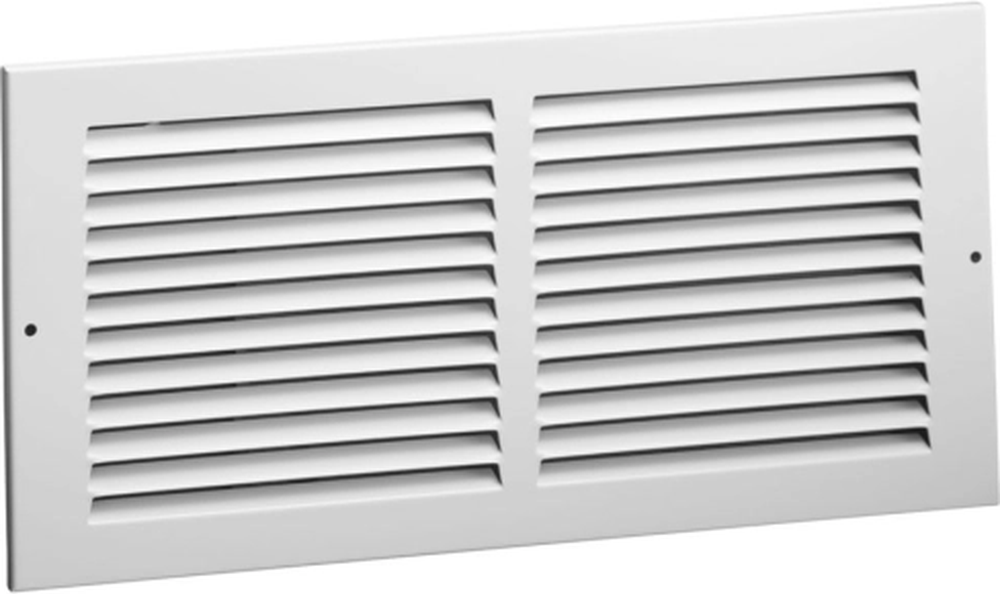
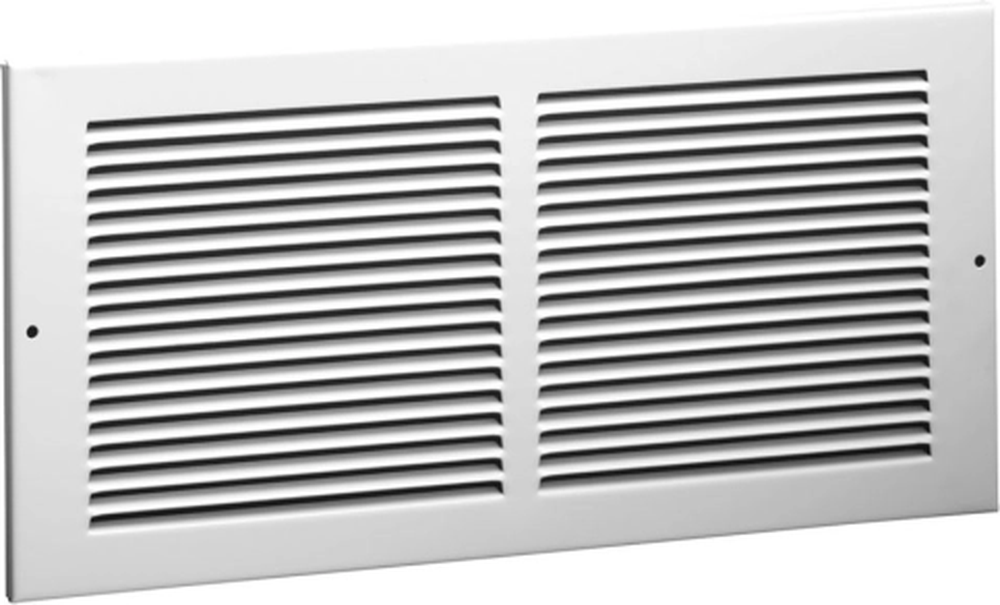
| Stamped fin, shallow | 1/3 in fins at 20° | Ak ≈ 67–70% of nominal1 | Partly | Low (0.029 in. w.g. @ 500 FPM) | Residential sidewall and ceiling returns |
| Stamped fin, steep | 1/2 in fins at 40° | Ak ≈ 64–68% of nominal1 | Better | Higher (0.054 in. w.g. @ 500 FPM) | Budget returns where low velocity is easy |
| Fixed bar / fixed blade | Separate blades, 1/2–3/4 in, at 0°, 35° or 45° | Varies with blade depth | Yes, if deep enough (§3) | Handles higher velocity quietly1 | Commercial sidewall, high-wall returns |
| Egg crate | 1/2 in open cube cells | 74.3% of core (our 0.080 in rib) | No | Lowest | Ceiling returns, plenum returns, high CFM |
| Perforated face | Round holes, e.g. 3/16 in on 1/4 in stagger | 51.0% of core | Mostly (small holes) | Size larger to compensate | Lay-in ceilings matching perforated tiles, clean rooms |
| Filter grille | Any face above, hinged, 1 in filter rack | Set by the filter, not the face | Depends on face | Size to 2 CFM/in² of filter | Central returns without a filter at the air handler |
1 Hart & Cooley Residential Grilles, Registers & Diffusers catalogue, Edition 8, engineering data for the 650 (1/3 in fins at 20°) and 672 (1/2 in fins at 40°) return grilles, and their sizing notes on fixed-bar models. Egg crate and perforated percentages are calculated geometry for the core only. See §4 and §5.
Our own range maps onto these rows: 650/A650 stamped returns with 1/3 in fin spacing, 672/A672 with 1/2 in spacing, 94A 35° fixed blade, RH45T 45° deflection, RE5 aluminum egg crate and PFG perforated face, plus 17 filter grille variants. The full set is on the return air grilles page.
2. Stamped Fin Grilles: The 86% Pressure Penalty of a Steeper Fin
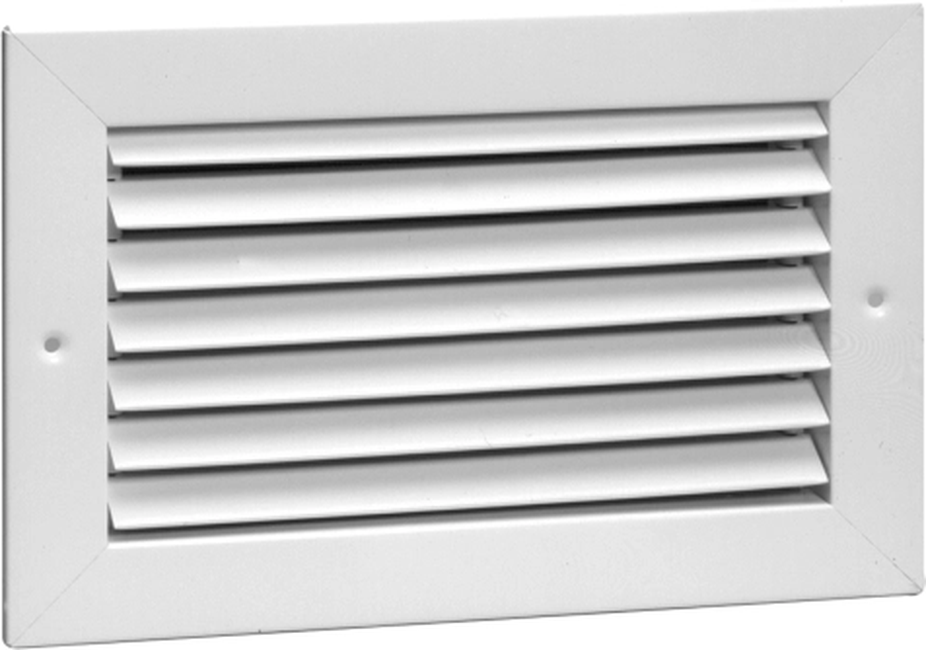
Stamped fin grilles (the "inclined fin" or "louvered face" return in many catalogues) are the cheapest return you can buy. They come from a single sheet of steel or aluminum, with the fins lanced and bent out of the face in one press stroke. No separate blades, no assembly, and a rigid face that survives a vacuum cleaner.
Two fin patterns dominate. Hart & Cooley's residential catalogue describes them exactly: the 650 has "1/3" spaced fins set at 20 degrees" and the 672 has "1/2" spaced fins set at 40 degrees". Their engineering tables put the two side by side, and the comparison is the most useful single data point in this article:
| Size | 650 Ak (ft²) | 672 Ak (ft²) | 650 Ak / nominal | 672 Ak / nominal |
|---|---|---|---|---|
| 6 x 6 | 0.167 | 0.170 | 66.8% | 68.0% |
| 12 x 12 | 0.681 | 0.660 | 68.1% | 66.0% |
| 20 x 20 | 1.917 | 1.800 | 69.0% | 64.8% |
| 24 x 24 | 2.775 | 2.580 | 69.4% | 64.5% |
| Pressure loss @ 500 FPM | 650: 0.029 in. w.g. · 672: 0.049–0.054 in. w.g. | +69% to +86% for the 40° fin | ||
Source: Hart & Cooley Residential GRD catalogue, Edition 8, pp. 47–48. Face velocity in that data is measured 1 in from the face. Ak / nominal is our calculation (Ak × 144 ÷ nominal in²).
Read across a row. The effective areas are within 7% of each other at every size, and at 6x6 the 40° grille is actually slightly larger. If you were choosing on free area, these would be the same product. They are not. At the same face velocity the 40° fin loses 0.049–0.054 in. w.g. against 0.029: 69% more on a 24x24, 86% more on small sizes.
The reason is that the air has to change direction to get through a steep fin, and turning losses grow with the turning angle. Area tells you how big the doorway is. Angle tells you how sharp the corner is behind it.
Pressure loss scales with velocity squared, so you can convert that penalty into face area. For the 672 to drop to 0.029 in. w.g., face velocity has to fall to 500 × √(0.029 / 0.054) = 366 FPM. That is 27% less velocity, and therefore about 37% more Ak, for the same airflow. Hart & Cooley state the practical version in their sizing notes: "Low velocity reduces noise, especially on stamped face grilles (672/673)."
One more thing in that catalogue is worth knowing. The pressure column is identical for every size, from 6x4 to 36x8, and the Ak ratio barely moves. That is the signature of a table scaled from reference sizes, which is exactly what Hart & Cooley's own sizing page tells you to do for unlisted sizes ("using the listed 12x6 cfm and halving it will give the answer for a 6x6"). That is reasonable from 12x12 up. On 6x6 and 8x8 returns the fixed frame margin takes a much bigger bite, so real open area runs lower than a scaled table implies. Our grille free area vs Ak factor guide works that effect through size by size.
Sizing a return schedule with mixed core types?
Send us the CFM per opening and the core you want. We return nominal sizes, blade or hole geometry and calculated free area per size. MOQ 100 pcs per size.
Request a return grille quote3. Fixed Bar Grilles: When Angle Actually Hides the Duct
A fixed bar (or fixed blade) grille uses separate, deeper blades held in the frame instead of fins pressed from the face. That costs a few dollars more per unit and buys two things. First, the blades are profiled rather than sheared, so the air turns more smoothly. Hart & Cooley's note is that "fixed-bar grilles can handle more velocity without noise (94A/96AFB/RH45/RHF45/RCB)". Second, deeper blades are what actually block the view into the duct.
Whether a bladed grille is sight-proof is geometry, not marketing. Looking straight at the face, each blade casts a "shadow" equal to its depth times the sine of its angle from the face normal. If that shadow is at least the blade spacing, you cannot see through:
Sight-proof straight-on when: blade depth × sin(θ) ≥ blade spacing
| Blade spacing | Deflection θ (from face normal) | Minimum blade depth for sight-proof | Gap between blades (per inch of spacing) |
|---|---|---|---|
| 1/3 in | 20° | 0.97 in | 94% |
| 1/2 in | 35° | 0.87 in | 82% |
| 1/2 in | 40° | 0.78 in | 77% |
| 1/2 in | 45° | 0.71 in | 71% |
| 3/4 in | 35° | 1.31 in | 82% |
| 3/4 in | 0° (straight) | Never sight-proof | ~100% |
Our calculation. Gap per inch = cos θ, before subtracting blade thickness. Blade depth is the blade chord measured along the blade, not the overall frame depth.
The last column shows why steeper is not free. The perpendicular gap between blades shrinks with cos θ, so a 45° blade passes air through a channel only 71% as wide as its spacing, and the air has to turn 45° to enter it. A 0° blade hides nothing but is almost a straight pipe. That is why Krueger and others offer the same fixed blade grille at 0° or 35°. Pick 0° for a high-wall return nobody looks into, and 35°–45° at eye level.
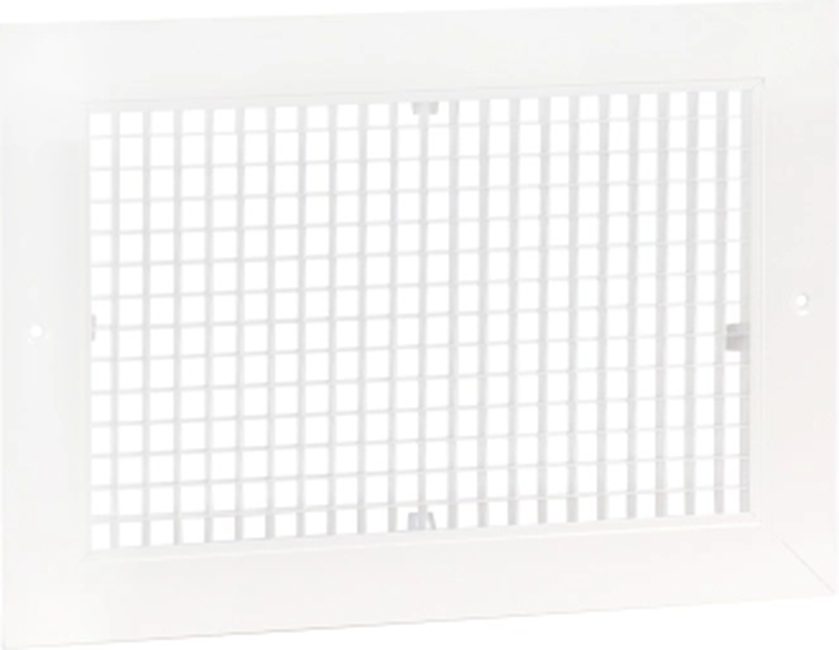
Watch the angle convention. Rectorseal describes its fixed bar return as blades "set at 75 degrees from the face", which is 15° from the normal in the convention above. Our own catalogue lists an RH90 "90-degree fixed blade", meaning blades perpendicular to the face, which is 0° deflection. A "45°" grille is 45° either way, but a "35°" quote from one supplier and a "55°" quote from another may be the same blade. Write "deflection measured from the face normal" into the spec and the ambiguity disappears.
4. Egg Crate Grilles: Most Open, Least Hidden
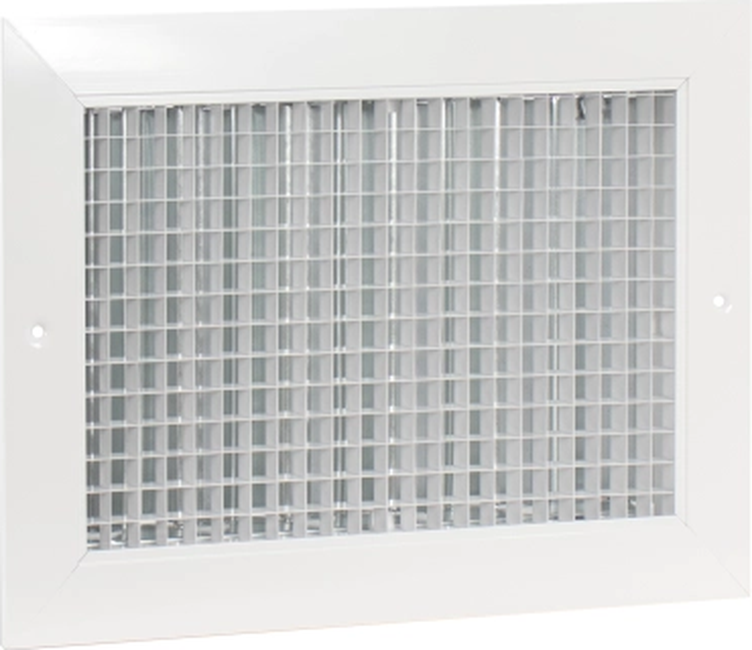
An egg crate (cube core) grille is a lattice of thin aluminum strips forming open square cells, typically 1/2 x 1/2 x 1/2 in. The air goes straight through with no turn, so for the same nominal size it is the quietest and lowest-pressure return core you can buy. Lightweight foil cube cores are advertised at up to 90% free area of the core. Our heavier half-inch grid with 0.080 in ribs calculates to (0.500 ÷ 0.580)² = 74.3%, and we quote that figure rather than the marketing one.
The trade-off is concealment: you can see straight through an egg crate core into the duct or plenum. On a lay-in ceiling over a dark plenum that rarely matters. On a wall at eye level opposite a sofa, it usually does. Our egg crate vs linear bar grille comparison covers the aesthetic side of that choice in detail.

Egg crate is also the default for ceiling plenum returns, where the grille opens into the plenum space rather than a duct and the lowest possible pressure drop matters. If you are deciding whether to duct the return at all, read ceiling plenum space guide first.
5. Perforated Face Grilles: Calculate the Open Area Yourself
Perforated face returns ("return grids with perforated screen" in some markets) use a punched steel or aluminum sheet instead of fins or cells. Architects specify them because they disappear into perforated ceiling tiles and read as a flat panel. They are also easy to wipe down and hard to poke things through.
Their open area is not a mystery number to take from a brochure. For round holes on 60° staggered centres, the standard perforated-metal formula (McNichols, among others) is:
Open area % = 90.69 × (hole diameter ÷ centre spacing)²
| Hole / centres (60° stagger) | Sheet open area | Overall, 24x24 (core 89.9%) | Overall, 12x12 (core 80.3%) | Overall, 6x6 (core 62.7%) |
|---|---|---|---|---|
| 1/8 in on 3/16 in | 40.3% | 36.2% | 32.4% | 25.3% |
| 3/16 in on 1/4 in (most common) | 51.0% | 45.9% | 41.0% | 32.0% |
| 1/4 in on 5/16 in | 58.0% | 52.2% | 46.6% | 36.4% |
| 3/16 in on 5/16 in | 32.6% | 29.4% | 26.2% | 20.5% |
Our calculation. Core fractions assume a 5/8 in frame flange per side, as in our free area guide. These are geometric free areas, not tested Ak ratings.
The 3/16 in on 1/4 in pattern is what Krueger lists for its perforated returns, and Price quotes 51% free area for its perforated return. Both match the formula exactly, which tells you the figure refers to the sheet, not the whole grille. Compare it with the 74.3% egg crate core: at the same velocity through the holes, a perforated face needs 74.3 ÷ 51.0 = about 46% more core area. In practice that usually means one step up in nominal size.
The last row of the table is the trap. A finer-looking "3/16 on 5/16" sheet sometimes gets substituted because it is stiffer and looks almost the same. It is only 32.6% open, so a return sized for 51% is suddenly running about 56% faster through the holes. If a sample arrives with wider hole spacing than you specified, that is the reason to reject it.
6. Filter Grilles: Two Rules That Disagree
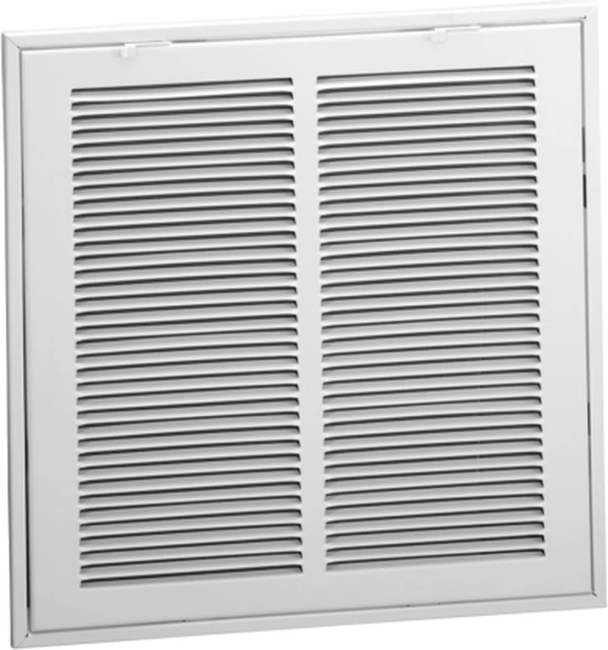
A filter grille is any of the faces above, mounted on a hinged door with a rack for a standard 1 in filter behind it. It is the right choice when the air handler has no filter slot of its own, typically one or two central returns in a house or light commercial unit. Once a filter is in the path, the filter sets the size, not the face.
Hart & Cooley's engineering pages give two rules that point in slightly different directions. The first is a typical capacity of 2 CFM per square inch of nominal filter area, with 300–450 FPM recommended and 450 FPM as the maximum for filter returns. The second is ACCA guidance of 300 FPM maximum for filter grilles versus 500 FPM for non-filter grilles. They are closer than they look: 2 CFM/in² × 144 = 288 FPM across the filter face. Use 2 CFM/in² as your default and you satisfy both.
| Return CFM | Filter area needed (2 CFM/in²) | Standard filter grille size | Nominal tonnage (400 CFM/ton) |
|---|---|---|---|
| 400 | 200 in² | 14x14 (196) or 20x10 (200) | 1 ton |
| 600 | 300 in² | 20x16 (320) or 14x24 (336) | 1.5 ton |
| 800 | 400 in² | 20x20 (400) | 2 ton |
| 1,200 | 600 in² | 24x25 (600) or 20x30 (600) | 3 ton |
| 1,600 | 800 in² | 30x30 (900) or two 20x20 | 4 ton |
Based on the Hart & Cooley filter sizing table (e.g. 14x14 = 1 ton / 400 CFM; 24x24 = 3 ton / 1,200 CFM). Their filter grille data is tested without filters. Add the filter's own pressure drop from its datasheet.
That footnote matters more than the table. The grille's catalogue pressure loss is measured without a filter, and a pleated MERV 8–13 filter at 300 FPM can add several times the grille's own loss. If the owner wants MERV 11 or 13, go one size up from the table. Our MERV rating and filter types guide has the resistance figures. The filter grilles vs registers vs diffusers guide covers where a filter grille belongs in the system.
7. Options: Dampers, Insulated Backs and Door Transfer Grilles
Three add-ons change how a return grille behaves without changing its core type.
- Opposed blade damper (OBD). Worth adding only when there are several returns that need balancing against each other. Hart & Cooley's guidance is blunt: "You really can't oversize a single point return… This does not apply to multiple return locations where balancing is more critical." On a single central return a damper only adds resistance. Our RED5 egg crate with OBD is the multi-return version.
- Insulated back. A foil-faced or fibreglass back panel on ceiling returns that open into hot attics or unconditioned plenums. It reduces condensation on the grille and heat gain through it.
- Door transfer grilles. A pair of grilles through a door (TG/TGF), used to give a closed room a return path to the hallway. There is no fan pushing air through these, so this is the one place where free area arithmetic really is the right sizing tool.
Location matters more than any option. Hart & Cooley note that returns "only grab air about a duct diameter away from the face". A return does almost nothing for room air movement, and the supplies do the mixing. Put returns in stagnant spots, away from the throw of a supply diffuser, and stop worrying about whether a return "pulls" air across the room.
8. Worked Example: One 800 CFM Return, Four Answers
Take a 2-ton system with a single 800 CFM central return in a hallway ceiling, and a design target of about 0.03 in. w.g. across the grille. Here is what each core type needs, using published tables where they exist and geometry where they do not:
| Core | Sizing basis | Smallest size that works | Nominal area | vs smallest |
|---|---|---|---|---|
| 1/3 in fin @ 20° | H&C 650 table, 500 FPM → 803 CFM, 0.029 in. w.g. | 24x14 | 336 in² | baseline |
| 1/2 in fin @ 40° | H&C 672 table at ~366 FPM for the same 0.029 → Ak ≥ 2.19 ft² | 20x24 (Ak 2.16, ≈0.028 in. w.g.) | 480 in² | +43% |
| 1/2 in fin @ 40°, same size as 650 | 24x14 at ~527 FPM listed | 24x14 works on airflow | 336 in² | ≈0.06 in. w.g., 2× the pressure |
| Filter grille, 1 in filter | 2 CFM/in² of filter (= 288 FPM) | 20x20 (24x24 for MERV 11+) | 400–576 in² | +19% to +71% |
Grille sizes and Ak values from the Hart & Cooley Residential GRD catalogue, Edition 8. 672 pressure at ~527 FPM estimated from its 500/600 FPM columns. For egg crate and perforated cores, use the tested NC/pressure table for the specific product. As geometry, perforated (3/16 on 1/4) needs about 46% more core area than a 1/2 in egg crate at the same through-hole velocity.
The same return can legitimately be a 24x14 or a 20x24, a 43% difference in drywall cut-out, without either designer making an arithmetic mistake. The difference is entirely fin angle. If a drawing specifies a size based on one core type and the contractor substitutes the cheaper steep-fin version at the same size, the grille still passes the airflow but at roughly twice the pressure. That is the classic "whistling return" callback.
For a full CFM-to-size method on the return side, use our return air grille sizing guide. If the return is too loud and cannot be made bigger, the duct noise reduction guide covers the downstream options.
9. How to Specify a Return Grille So You Get What You Sized
"Return air grille, white, 24x14" describes at least six different products. A spec that survives substitution has these lines:
- Core type: stamped fin, fixed bar, egg crate, perforated, or filter (with which face).
- Core geometry: fin or blade spacing and deflection measured from the face normal; cell size and rib thickness; or hole diameter and centre spacing with the pattern (60° stagger or straight).
- Blade depth where sight-proofing matters, checked against §3.
- Nominal size, frame margin and core dimensions, so free area can be recalculated from the drawing.
- Performance basis: the CFM and maximum pressure or NC at that size, taken from a table for that exact core.
- Material and finish: steel or aluminum, powder coat colour. Aluminum for humid or coastal sites.
- Options: OBD, insulated back, filter size and thickness, hinge side, fastening (screws vs spring clips).
Every item on that list can be checked on a sample with calipers and a ruler, and that is how we expect our customers to check us. We build stamped steel and aluminum returns and filter grilles in 1 in size increments. MOQ is 100 pcs per size, with a first-article sample before every run and a lead time of 25–35 days from approved drawing at our 5,000 m² Dongyang plant. UL and CE documentation is available for the construction. Buyers new to importing GRD should also read our HVAC parts sourcing and import guide.
Related Guides
- Grille Free Area vs Ak Factor: why free area changes with size, and what Ak really is
- Egg Crate vs Linear Bar Grille: the two architectural return styles compared
- Return Air Grille Sizing Guide: CFM, face velocity and placement
- Filter Grilles vs Registers vs Diffusers: where each belongs in the system
- Grille vs Register vs Diffuser: the basic terminology
- Drop Ceiling Diffusers: lay-in sizes and grid fit for the supply side
Sources
- Hart & Cooley, Residential Grilles, Registers & Diffusers, Edition 8: 650/A650 and 672 product descriptions (fin spacing and angle), engineering data pp. 39–40 and 47–48 (Ak, pressure loss, ACCA face velocity limits, filter sizing, unlisted-size scaling).
- McNichols, perforated metal open area formulas: 60° staggered round holes, D² × 90.69 ÷ C².
- Krueger fixed blade (0°/35°, 1/2 and 3/4 in spacing) and perforated (3/16 in on 1/4 in staggered) return grille catalogue data; Price Industries perforated return (51% free area).
- Rectorseal model 270 fixed bar return: blade angle "75 degrees from the face".
- ANSI/ASHRAE Standard 70-2023, Method of Testing the Performance of Air Outlets and Air Inlets.