Toe Kick Register Guide: Sizes, CFM & Duct Sizing (2026)
Toe kick register sizes (2x10, 2x12, 2x14), CFM per grille, stack duct sizing, IRC kitchen code rules and install tips. Factory-direct since 1996, MOQ 100.
Quick Answer
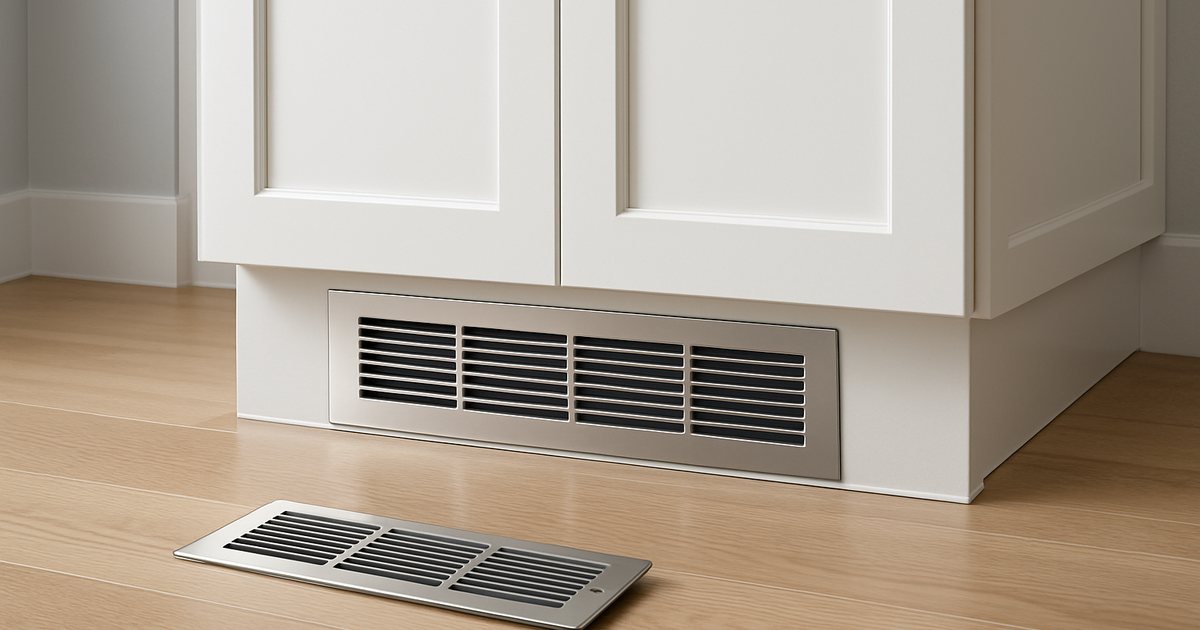
A toe kick register is a low-profile supply grille mounted in the recessed toe space under kitchen and bathroom base cabinets. Standard duct openings are 2-1/4 x 10, 2-1/4 x 12 and 2-1/4 x 14 in. Design for no more than about 50 / 60 / 70 CFM respectively to stay quiet, feed a 2-1/4 x 12 stack with a 6-inch round duct, and never use a toe kick as a kitchen return within 10 ft of the range (IRC M1602.2).
Every kitchen remodel runs into the same problem. The wall that used to hold a floor register is now covered by a continuous run of base cabinets, and the island sits right where the heat needs to go. The fix is the toe kick register: a slot grille about 2 inches tall that fits in the recessed toe space under the cabinet box.
Most toe kick content online is written for homeowners picking a finish. This guide is written from the other side of the order: we stamp toe kick grilles and baseboard registers in Dongyang, China, and ship them to HVAC distributors, cabinet makers and contractors. It covers what the retail pages leave out: toe kick register sizes against real CFM, how to size the flat stack duct behind the grille, the two code sections that catch installers out, and what to put in a purchase spec if you buy them by the carton.
In This Guide
1. Toe Kick Register Sizes and Airflow
Toe kick registers are named by the duct opening they cover, not by the grille face. A "12 x 2" grille covers a hole about 12 inches wide and 2 to 2-1/4 inches tall, and its face is roughly 1 to 1-1/4 inches larger in each direction. Standard cabinet toe kicks are 3-1/2 to 4 inches tall with a 3-inch setback, so a face of about 3-1/8 inches leaves enough reveal top and bottom.
The number that matters is free area, which is the open area between the fins after the steel is subtracted. A 10 x 2 inch stamped steel toe space grille with 1/2-inch multi-angle fin spacing is published at 15 sq in free area and 35-85 CFM. That is about 67% of the gross opening, which is typical for stamped fin grilles. The 12 x 2 size is published at 30-100 CFM.
| Duct Opening (in) | Typical Face (in) | Free Area (sq in) | Quiet CFM (≤500 FPM) | Published Max CFM | Typical Use |
|---|---|---|---|---|---|
| 2-1/4 x 10 | 3-1/8 x 11-1/8 | 15 | 50 | 85 | Vanities, small kitchens, pantry cabinets |
| 2-1/4 x 12 | 3-1/8 x 13-1/8 | ~18* | 60 | 100 | Most kitchen perimeter and island runs |
| 2-1/4 x 14 | 3-1/8 x 15-1/8 | ~21* | 70 | ~115* | Large islands, open-plan kitchens |
*Estimated at the same 67% free-area ratio as the published 10 x 2 grille. Always confirm with the supplier's data sheet. Airwise supplies free-area data with every quotation.
Why we recommend 500 FPM, not the published maximum: at 85 CFM, a 10 x 2 grille pushes air through its 15 sq in free area at about 816 FPM (85 ÷ 15 × 144). A toe kick outlet sits 2 inches off the floor and about 3 feet from the occupant's ankles, so that velocity is both audible and felt as a draft. At 500 FPM it is neither. The formula you need is Free-area velocity (FPM) = CFM ÷ free area (sq in) × 144, the same one we use in our CFM duct sizing calculator.
2. Sizing the Duct Behind the Grille
This is where most toe kick installations lose airflow. A toe kick can't take a round duct, so the branch has to transition to a flat rectangular stack, usually 2-1/4 inches deep, to fit behind the kick board. Flat ducts have much more friction than their area suggests.
The ASHRAE equivalent-diameter equation (ASHRAE Handbook — Fundamentals, Duct Design chapter), De = 1.30 × (ab)0.625 ÷ (a + b)0.25, gives the round duct size with the same friction loss as a rectangular duct. Run it for the standard toe kick stacks and the gap is clear:
| Stack Size (in) | Gross Area (sq in) | Round Duct with Same Area | Round Duct with Same Friction (De) | Feed with |
|---|---|---|---|---|
| 2-1/4 x 10 | 22.5 | 5.35 in | 4.86 in | 5 in round |
| 2-1/4 x 12 | 27.0 | 5.86 in | 5.25 in | 6 in round |
| 2-1/4 x 14 | 31.5 | 6.33 in | 5.59 in | 6 in round |
| 3-1/4 x 10 (wall stack, for comparison) | 32.5 | 6.43 in | 6.00 in | 6 in round |
A 2-1/4 x 12 stack has the area of a 6-inch round duct but the friction of a 5-1/4-inch one. In practice that means three rules:
- Feed the stack with a full-size round branch. Run a 6-inch round to a 2-1/4 x 12 or 2-1/4 x 14 toe kick boot, and a 5-inch round to a 2-1/4 x 10. A 5-inch branch to a 12-inch grille starves it.
- Keep the flat section short. Transition to the flat stack as close to the grille as possible, ideally within the last 2-3 feet under the cabinet. A long flat run through a joist bay loses much more pressure than the same length of round.
- Remember the grille is last in line. A toe kick branch is often the longest effective run from the air handler once you add the boot, two elbows and the flat stack. If the Manual D friction budget is tight, this is the branch that underperforms.
Worked example: a Manual J load gives a 180 sq ft kitchen 110 CFM of supply, and the only open walls are behind the range hood and the window. Two toe kick grilles split the load at 55 CFM each. A 2-1/4 x 12 grille (~18 sq in free) at 55 CFM runs at 440 FPM, which is quiet. Each gets a 6-inch round branch, a 6-in-round to 2-1/4 x 12 toe kick boot, and a balancing damper at the take-off. A single 2-1/4 x 14 grille at 110 CFM would run at about 750 FPM and whistle.
3. Code Rules: Supply vs Return, and Why You Can't Blow Into the Cabinet
None of the top-ranking toe kick guides mention the code, and the two sections below cause most failed rough-in inspections on cabinet installs.
IRC M1602.2, return air openings. Return air shall not be taken from a closet, bathroom, toilet room, kitchen, garage, mechanical room, boiler room, furnace room or unconditioned attic. The kitchen exception allows return openings that serve the kitchen only and are at least 10 feet (3,048 mm) from the cooking appliances. The concern is grease and combustion by-products being drawn into the duct system and spread through the house.
IRC M1601.1.1, building cavities. Stud cavities and joist spaces may be used as return air plenums under strict conditions, but they shall not be used as a plenum for supply air. An open cabinet base is a building cavity. Terminating the supply duct inside the cabinet and letting air escape through the kick is a code violation. It also heats whatever is stored in the cabinet and leaks conditioned air into the wall.
| Location | As Supply | As Return | Code Reference |
|---|---|---|---|
| Kitchen base cabinet next to range | Yes (ducted) | No — within 10 ft of cooking appliance | M1602.2 exception 1 |
| Kitchen cabinet ≥10 ft from range, kitchen-only return | Yes (ducted) | Yes | M1602.2 exception 1 |
| Bathroom vanity | Yes (ducted) | No | M1602.2 |
| Laundry or utility cabinet | Yes (ducted) | Check local code | M1602.2 |
| Any cabinet, duct ending inside the box | No | — | M1601.1.1 |
Local amendments vary. Confirm with the authority having jurisdiction before rough-in. Commercial projects fall under the IMC rather than the IRC.
4. Types, Materials and Price
Four product types compete for the toe space. They look similar in the cabinet but differ in price, control and lead time.
| Type | Construction | Airflow Control | US Retail (each) | Factory FOB (500+ pcs) | Best For |
|---|---|---|---|---|---|
| Stamped steel toe space grille | Cold-rolled steel, multi-angle fins, baked enamel or powder coat | None (fixed fins) | $12-20 | $1.50-3.00 | Volume builders, replacement stock |
| Steel register with damper | Steel face + plate or multi-shutter damper | Adjustable, 0-100% | $15-28 | $2.20-3.80 | Short, over-supplied runs; islands |
| Wood toe kick vent | Oak, maple or cherry, unfinished or pre-finished | Usually none | $25-60 | Species-dependent | Matching custom cabinetry |
| Kick-space heater | Fan unit with electric or hydronic coil | Thermostat | $150-500 | — | Rooms without ductwork (not a register) |
Retail prices are from US supply-house and online listings (a 10 x 2 inch white steel toe space grille lists at around $16). FOB figures are our typical factory range for standard finishes and move with steel price and order mix. Wood and fan-forced units are included for comparison. Airwise manufactures the two steel types.
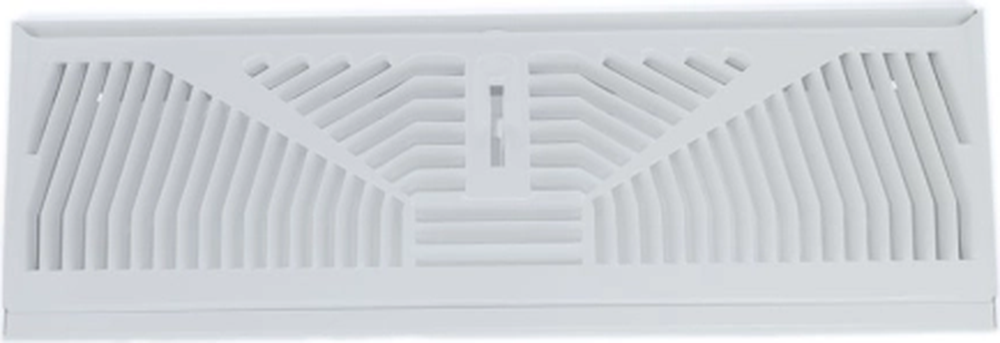
Finish is where cheap grilles fail. A toe kick gets kicked, mopped and splashed more than any other register in the house. Specify electrostatic powder coat rather than wet paint, and ask for the salt-spray hours (ASTM B117) on the data sheet. A finish that chips at the fin edges shows rust within a year near a dishwasher or sink base.
5. Toe Kick vs Baseboard vs Floor Register
If the wall isn't fully covered by cabinets, a toe kick may not be the best outlet. Here is how the three low-level options compare. For the wider family of outlets, see our grille vs register vs diffuser guide.
| Factor | Toe Kick Register | Baseboard Register | Floor Register |
|---|---|---|---|
| Face height | ~3-1/8 in | ~4-1/2 in (e.g. 4.5 in ht models) | Flush with floor |
| Typical CFM per unit | 50-70 (quiet) | 60-150 (2-4 ft lengths) | 50-120 (4x10 to 4x14) |
| Needs cabinet | Yes | No — replaces baseboard trim | No |
| Foot traffic / debris | Protected by cabinet | Protected | Collects debris, walked on |
| Throw into room | Short, along floor | Medium, up the wall | Vertical plume |
| Best application | Kitchens, vanities, built-ins | Retrofits, rooms with no floor access | Standard perimeter supply |
Browse the full baseboard and toe kick register range, or compare standard openings in our floor register sizes guide.
6. Installation and Common Mistakes
The installation takes about 30 minutes once the duct is roughed in. The five steps:
- Rough in the branch before the cabinets arrive. Bring a 5- or 6-inch round branch up through the subfloor at the cabinet location and fit a toe kick boot (round-to-2-1/4 x 10/12/14 transition). Seal every joint with mastic or UL 181 listed foil tape. See our duct sealing methods guide.
- Cut the kick board opening to the duct size, not the grille face. For a 12 x 2 grille, cut 12 x 2-1/4 in. Hold the cut to about ±1/8 in, because the grille flange only covers 1/2 to 5/8 in of overlap.
- Connect boot to kick board with no gap. The boot outlet should butt against the back of the kick board, with foam gasket or mastic around the perimeter so air can't bypass into the cabinet void.
- Fasten the grille with the two supplied screws into the kick board. On adjustable cabinet legs with clip-on kick plates, screw a wood backer to the plate first.
- Balance. Measure airflow with a flow hood or a vane anemometer across the free area and set the damper. Our HVAC air balancing guide covers the procedure.
The mistakes we see most often in contractor feedback:
- Open duct into the cabinet base. Violates M1601.1.1, heats the cabinet and wastes air.
- A 5-inch branch feeding a 14-inch grille. The grille looks right but delivers 40-50% of design airflow.
- A toe kick return next to the range. Fails M1602.2 at inspection.
- No damper on a short island run. The island gets a blast of air while the far bedroom starves.
- Grille aimed at the dishwasher or refrigerator toe grille. Warm supply air into a refrigerator's condenser intake raises its energy use. Offset the grille at least one cabinet width.
7. Buying in Volume: Spec, MOQ and Lead Time
If you buy toe kick grilles for a distribution shelf, a cabinet line or a tract-home program, the retail listing tells you almost nothing. These are the lines we recommend putting on the RFQ. They are also the questions we ask when a distributor sends us a sample to match.
| Spec Item | Typical Value | Why It Matters |
|---|---|---|
| Duct opening sizes | 2-1/4 x 10 / 12 / 14 in (metric: 57 x 254 / 305 / 356 mm) | Must match North American cabinet cutouts |
| Free area | ≥65% of gross opening, stated in sq in | Determines quiet CFM; retail listings rarely state it |
| Material | Cold-rolled steel; aluminum for coastal markets | Rigidity against kicks and mops |
| Finish | Electrostatic powder coat; white, golden sand/brown, black, custom RAL | Chip and corrosion resistance |
| Damper | None / plate / multi-shutter | Balancing on short runs |
| Certification | UL / CE per market | Distributor and code-official acceptance |
| Packing | Individual poly bag, 50 or 100 pcs per master carton, or retail blister | Shelf-ready vs job-site bulk |
| MOQ | 100 pcs standard; 500 pcs custom color/size | Lets distributors mix SKUs in a first order |
| Lead time | 15-25 days standard; 30-45 days custom | Plan around the cabinet delivery schedule |
Mix SKUs to reach MOQ. Toe kick grilles are small and light, and a master carton of 100 weighs only a few kilos. Most of our distributor customers add them to an order of floor registers, return air grilles and baseboard registers rather than shipping them alone. Freight per piece is then negligible. Our wholesale grilles and diffusers guide covers pricing tiers, and how to source HVAC parts from China covers the import steps.
What Airwise supplies for toe space and baseboard applications:
- Model 420 steel toe kick — multi-angle fin toe space grille for under-cabinet supply.
- Model 654 baseboard register with plate damper and Model 664 with multi-shutter damper — for runs that need balancing.
- Model 406 / 407 baseboard supply and return, 4.5 in height — where the wall isn't covered by cabinets.
- Custom sizes and colors — matched to your cabinet line's toe kick height and finish, from 500 pcs.
We have manufactured air distribution products since 1996, with a 5,000 m² factory in Dongyang, Zhejiang, and a Houston, TX facility for North American stock. Send your size mix and quantities and we'll return an FOB quotation within 12 hours.
Request a quote for toe kick registers
Related Guides
- Floor Register Sizes Guide — standard sizes, how to measure and CFM per size.
- Decorative Floor Register Guide — materials, patterns and finishes for visible registers.
- CFM Duct Sizing Calculator — branch duct sizing by CFM and friction rate.
- Return Air Grille Sizing Guide — where returns can go when a toe kick can't be one.
- HVAC Air Balancing Guide — balancing short kitchen and island runs.