Best HVAC Vent Covers by Location: Floor, Wall, Ceiling & Return (2026)
"Vent cover" means a different product on a floor, a wall, a ceiling and a return opening. The best cover for each spot is decided by three things: whether it supplies or returns air, what it has to withstand there (feet, moisture, sight lines), and how the opening is measured. This guide gives the best cover type for each location and links to our detailed guide for each one.
Who wrote this and how we chose: this guide is written by Airwise, a grille, register and diffuser factory in Dongyang, China. We make most of the cover types below, so we do not rank brands or products, including our own. "Best" here means the best type of cover for each location, judged on four criteria: airflow function (supply or return), durability in that location, how it is sized, and relevant code rules (IRC 2021).
Numbers marked as ours come from our catalog and our own measurements; code references are listed under Sources.
Quick Answer
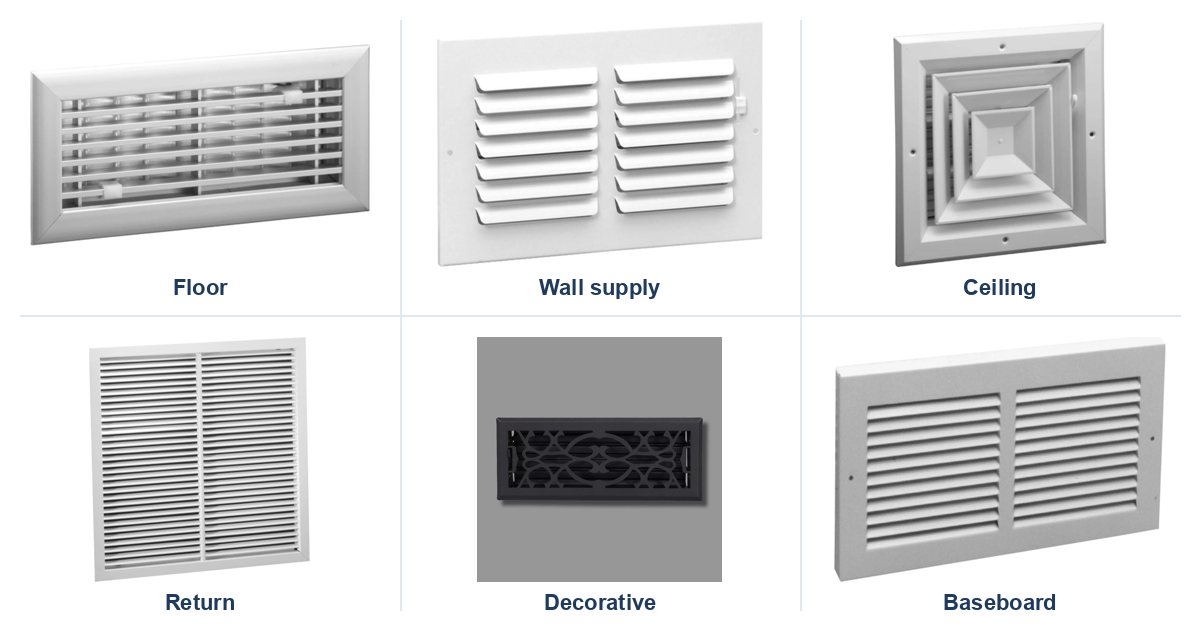
Floor: a steel floor register with a damper, sized by the duct opening (4x10 is the most common US size). Wall (inside): a sidewall supply register with a damper, or a return grille with none. Wall (outside): an exterior cap with a backdraft damper for exhaust, or a screened louver for intake. Ceiling: a diffuser for supply, because it spreads air along the ceiling instead of dropping it on people; a 2x2 lay-in unit for drop ceilings. Return: a fixed-blade or egg crate grille with no damper, sized for 400 to 500 FPM face velocity. Under cabinets and along baseboards: a low-profile toe-kick or baseboard grille. Decorative covers work in any of these spots if their open area is checked.
Key Takeaways
- Interior covers are sold by nominal opening size; the face is about 1.5 to 2 in larger. Measuring the old face instead of the hole is the most common ordering error.
- On the same 2x2 ceiling face, a 6 in neck moves about 95 CFM and a 14 in neck about 535 CFM at 500 FPM: on ceilings, the neck sets capacity, not the face.
- On our half-inch aluminum egg crate core, measured free area runs from 46.6% at 6x6 to 68.0% at 36x24, so small return grilles are far less open than their nominal size suggests.
- IRC M1602.2 bars return air from bathrooms, kitchens, closets, garages and mechanical rooms, with narrow exceptions (for example, a kitchen-only return 10 ft from cooking appliances, or a system serving only the garage). Location rules apply to returns, not just covers.
- Our range covers every location in this guide: 7 floor registers, 66 sidewall registers, 16 ceiling diffusers, 13 return grilles, 17 filter grilles, 11 baseboard and toe-kick grilles and 7 laser-cut decorative registers. MOQ starts at 100 pcs per model.
In This Guide
1. Best Vent Cover for Each Location: The Table
Find the row for the opening you are covering. Each row names the cover type that suits that spot best, the one feature it must have, how it is sized, and the mistake to avoid. The last column links to our full guide for that location.
| Location | Best cover type | Must have | Sized by | Avoid | Full guide |
|---|---|---|---|---|---|
| Floor supply | Steel floor register | Damper, load-bearing face | Duct opening (e.g. 4x10) | Thin aluminum in walkways | Floor register sizes |
| Wall supply (inside) | Sidewall register | Volume damper, throw direction | Nominal opening (e.g. 10x6) | Fixed return grille on a supply | Wall vent covers |
| Wall (outside) | Wall cap or hood | Backdraft damper (exhaust) or screen (intake) | Duct diameter | Screens on dryer vents | Wall vent covers |
| Ceiling supply | Ceiling diffuser | Multi-way throw | Neck size + grid module | Straight-blade wall grille as supply | Drop ceiling diffusers |
| Return (wall or ceiling) | Fixed-blade, stamped fin or egg crate grille | Low face velocity | Nominal size + return CFM | Dampers, magnetic covers | Return grille types |
| Return with filter | Filter grille | Hinged face, filter frame | Filter area (2 CFM per in²) | Undersized filter | Return grille types |
| Baseboard / toe kick | Low-profile register or grille | Shallow face | 2-1/4 x 10 / 12 / 14 in openings | Blowing into the cabinet void | Toe kick registers |
| Decorative (any) | Laser-cut register | Known open area | Same as the location | Dense patterns on tight returns | Decorative registers |
If the difference between a register, a grille and a diffuser is new to you, read our grille vs register vs diffuser guide first. The short version: a register has a damper, a grille does not, and a diffuser spreads supply air in several directions.
2. Floor Vent Covers
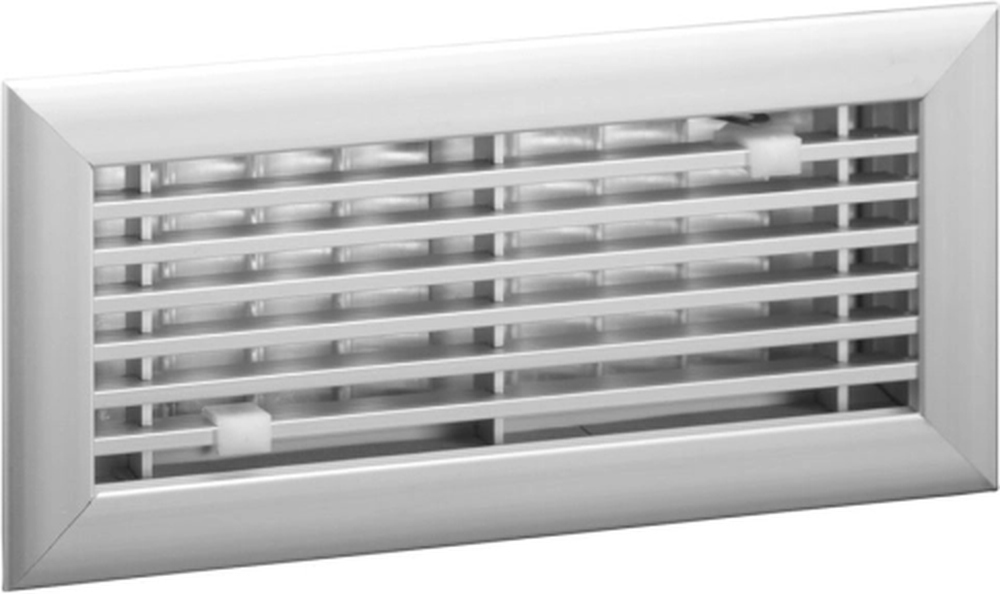
Best type: a steel floor register with a built-in damper. A floor cover gets stepped on, kicked and vacuumed, so the face has to carry load without bending. Steel is the default; aluminum is lighter and does not rust, which suits basements and bathrooms, but it can flex in walkways. Cast iron is the heavy-duty and period-home option.
Floor registers are sold by the duct opening. A 4x10 register fits a 4 x 10 in hole, and the face is about 1.5 to 2 in larger. 4x10 is the most common US residential size; living areas often use 4x12, 4x14 or 6x10 and up. Lift the old cover out and measure the hole, not the cover.
The full size chart, CFM per size and registers-per-room rule of thumb are in our floor register sizes guide. Our floor registers and grilles cover standard steel and heavy-duty models.
3. Wall Vent Covers (Inside and Outside)
Best type inside: a sidewall supply register with a multi-shutter or opposed blade damper. Curved blade faces throw air in one to four directions; double deflection faces let you set vertical and horizontal throw separately. A return opening on a wall takes a grille without a damper (see section 5).
Best type outside: an exterior wall cap chosen by the job of the duct behind it. Exhaust (bathroom fans, range hoods, dryers) needs a backdraft damper; dryer terminations must not have a screen (IRC M1502.3) and connect to a 4 in duct. Fresh-air intakes need the reverse: a fixed louver or hood with a pest screen, never an outward-opening flap.
We cover wall caps, dryer caps, intake hoods and interior wall covers job by job, with damper, screen and material rules, in our wall vent covers guide. Products: 66 sidewall register models and round metal wall vents.
Covering floors, walls and ceilings on one project?
Send one list by location, opening size and quantity. We quote floor registers, sidewall registers, ceiling diffusers and return grilles together, from 100 pcs per model.
Request a vent cover quote4. Ceiling Vent Covers
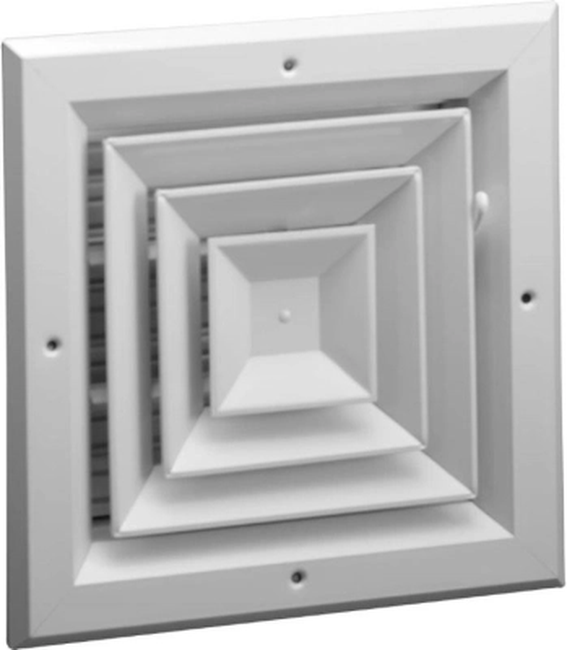

Best type for a ceiling supply: a diffuser, not a wall register. A diffuser spreads air in two, three or four directions so it travels along the ceiling and mixes before it reaches people. A ceiling register can work too: curved-blade registers rated for ceiling use deflect air along the ceiling in small rooms and hallways. What to avoid is a wall register or grille whose blades are not designed to turn the air, because it can drop cold supply air onto the people below. In offices and open rooms, use a diffuser.
In a drop ceiling, the cover is a 2x2 lay-in diffuser that rests on the grid. Capacity comes from the neck: on the same 24 x 24 in face, a 6 in neck moves about 95 CFM and a 14 in neck about 535 CFM at 500 FPM. Confirm the grid module (24 in or 600 mm) and tee width (15/16 or 9/16 in) before ordering. Details are in our drop ceiling diffuser guide, and face styles are compared in our HVAC diffuser types guide. Products: ceiling diffusers.
5. Return Air Vent Covers
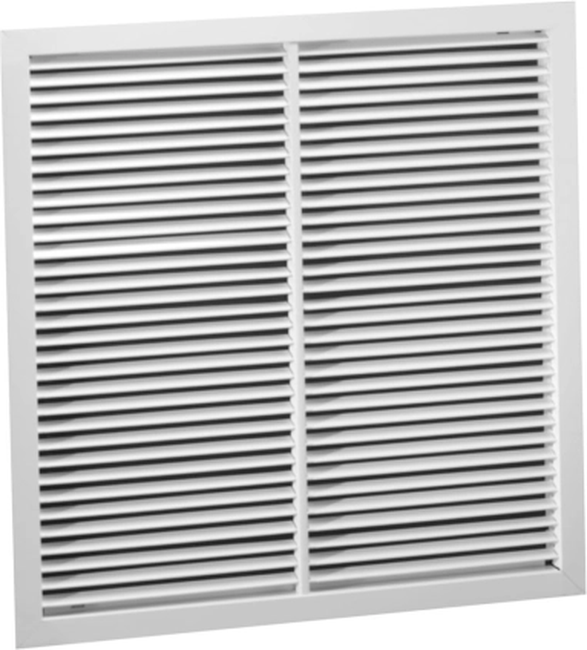
Best type: a fixed-face return grille with no damper. A return's job is to let room air back to the system quietly, so it should be as open as practical and sized generously. Size it on gross face velocity against the nominal size: about 400 to 500 FPM in occupied rooms. Choose the face by what it must hide and how quiet it must be: stamped fin is the low-cost standard, fixed bar hides the duct best, egg crate is the most open and quietest, perforated looks cleanest but is the least open.
Small returns are less open than they look. On our half-inch aluminum egg crate core, measured free area is 46.6% at 6x6 and 68.0% at 36x24, because the frame flange is a fixed width subtracted from a face that grows with the square of the size. Our free area vs Ak factor guide shows the math by size.
Two location rules matter for returns. IRC M1602.2 prohibits return air from bathrooms, kitchens, closets, garages and mechanical rooms. The exceptions are narrow: a kitchen return is allowed if it serves only the kitchen and sits at least 10 ft from cooking appliances, and a system that serves only a garage may take its return from that garage. And where the return holds the system filter, use a filter grille sized at about 2 CFM per square inch of filter. All five return faces are compared in our return air grille types guide; products: return air grilles.
6. Baseboard and Toe-Kick Vent Covers
Best type: a low-profile baseboard register or toe-kick grille. Where there is no room for a floor or wall register (under kitchen cabinets, along baseboards, under a bathroom vanity), a shallow grille does the job. Toe-kick grilles are sold as 10x2, 12x2 and 14x2 and fit 2-1/4 x 10, 12 and 14 in openings; for quiet operation, plan on about 50, 60 and 70 CFM respectively, so they suit small rooms or supplement a main register.
The common mistake is blowing supply air into the cabinet void instead of ducting it all the way to the grille. Duct sizing, stack ducts and the kitchen code rules are in our toe kick register guide. Products: baseboard and toe-kick grilles.
7. Decorative Vent Covers in Any Location
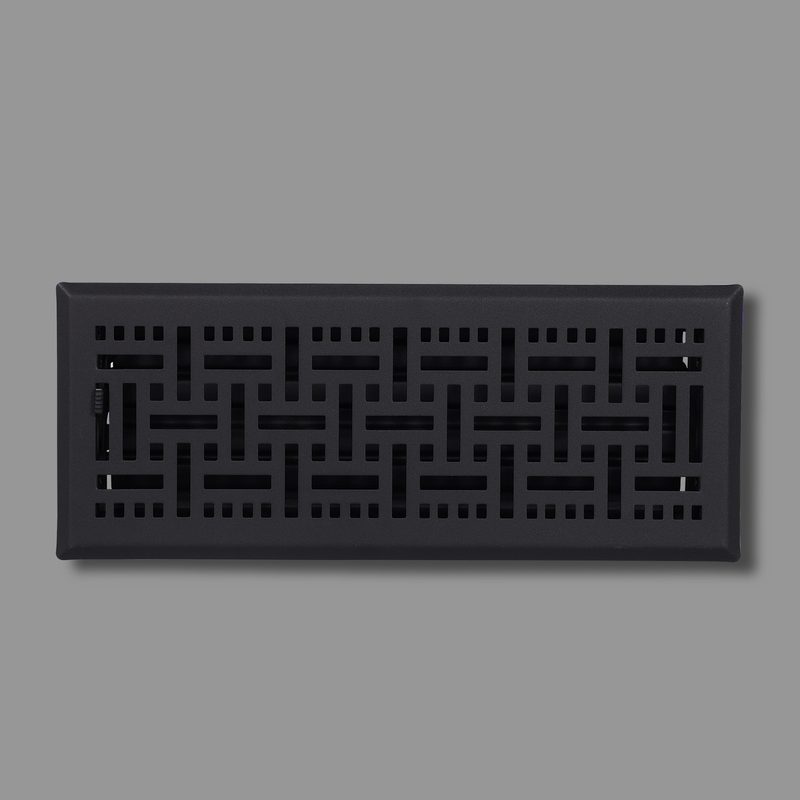
A decorative cover is a finish choice, not a separate location. A laser-cut steel register in matte black, satin nickel, antique brass or rose gold can sit in a floor, wall or ceiling opening, sized the same way as the standard cover it replaces. The one thing to check is open area: a dense scroll or woven pattern blocks more of the opening than a plain louver. That is rarely a problem on a supply register with spare capacity, but on a tight return it can add noise, so size up one step if the pattern is dense.
Patterns, finishes, two-tone options and sizes are in our decorative register guide. Products: laser-cut decorative registers.
8. Materials by Location
| Location | Best material | Acceptable | Why |
|---|---|---|---|
| Floor, walkways | Steel, cast iron | Aluminum in low-traffic spots | Foot traffic bends thin faces |
| Wall, dry rooms | Powder-coated steel | Aluminum | Low cost, paintable, no load |
| Bathrooms, basements | Aluminum | Coated steel with care | Humidity rusts cut steel edges |
| Ceiling | Aluminum or steel | Either | Weight matters on grid ceilings |
| Exterior wall | Stainless steel (316 near salt spray) | ABS on sheltered walls | Weather and UV exposure |
9. Buying Vent Covers in Bulk
Contractors, distributors and builders usually buy vent covers as a mixed list across locations and sizes. An RFQ that gets a usable quote on the first pass includes:
- Location and function per line: floor supply, wall supply, ceiling supply, return, filter return, toe kick, exterior.
- Size: nominal opening for interior covers; neck size and grid module for ceiling diffusers; duct diameter for exterior caps.
- Damper: yes for supply registers, normally no for returns.
- Material and finish: steel, aluminum or stainless; white powder coat or a named colour or decorative finish.
- Quantity per model and size, and packaging (bulk carton or individual retail box).
MOQ for standard catalog items starts at 100 pcs per model, and standard items typically ship in about 25–35 days by sea ex-China from our Dongyang plant. Custom patterns or finishes carry a higher MOQ; the exact MOQ and schedule per model are confirmed in the quotation. See our HVAC grilles, registers and diffusers supplier page for the full GRD range, or wholesale HVAC parts for stocking orders.
Related Guides
- Floor Register Sizes: size chart, CFM per size, registers per room
- Wall Vent Covers by Job: exhaust, dryer, intake and interior covers
- Drop Ceiling Diffusers: 2x2 sizes, neck CFM and grid fit
- Return Air Grille Types: fin, bar, egg crate, perforated and filter returns
- Toe Kick Registers: sizes, CFM and kitchen code rules
- Decorative Registers: patterns, finishes and sizes
Sources
- International Code Council, International Residential Code 2021: M1502.3 (dryer exhaust termination), M1602.2 (return air openings).
- ANSI/ASHRAE Standard 70, Method of Testing the Performance of Air Outlets and Air Inlets (basis for published diffuser and grille performance data).
- Airwise product catalog (model counts as listed on this site) and Airwise measurements of half-inch aluminum egg crate core free area.